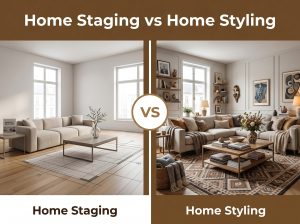
Before hiring an interior designer, the most important questions to ask cover five areas: their experience and specialisation, exactly what services are included in their fee, the total cost and payment structure, the project timeline, and how they make design decisions. Getting clear written answers to these questions before signing any agreement protects your budget, avoids miscommunication, and ensures the designer is the right fit for your specific project.
10 Questions You Should Ask An Interior Designer
1. What Is Your Experience and Area of Specialisation?
The first thing to ask is about experience. Not all designers do the same type of work. Interior design is a broad field. A designer who specialises in high-end new builds may have a completely different skill set to one who works on property styling, renovation projects, or compact urban apartments. Choosing a designer whose specialisation matches your project type gives you access to directly relevant experience rather than generalist knowledge.
Key questions to ask:
- How many years have you worked as an interior designer?
- What types of projects make up the majority of your work?
- Have you worked on projects similar to mine in scale, style, and budget?
- Do you have experience working with properties in my suburb or price bracket?
🚩 Red flag: A designer who claims to do everything with equal expertise but cannot show a portfolio that demonstrates range and depth. Specialisation produces better outcomes than vague generalism.
According to the Australian Institute of Architects, clients consistently report better outcomes when they choose professionals with demonstrated experience in their specific project type rather than selecting on price alone.
2. Can I See Your Portfolio and Client References?
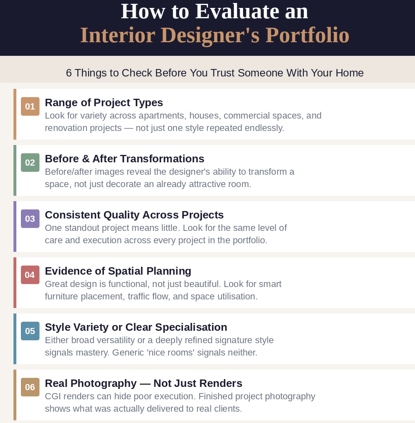
Ask to see a portfolio of completed projects, ideally including projects similar in size, style, and budget to yours
What to look for in the portfolio:
- Variety across different room types and property styles
- Evidence of both aesthetic quality and functional planning
- Projects at a similar scale and budget to yours
- Consistency of quality across multiple projects, not just one standout job
What to ask a reference:
- Did the project finish on time and within budget?
- How did the designer handle problems or unexpected issues?
- Would you hire them again?
Red flag: A designer who cannot provide references, or whose portfolio only shows one or two projects. Established professionals have a body of work they are proud to share.
3. What Services Are Included in Your Fee?
Interior design fees can cover a very wide or very narrow range of services, depending on the designer and the engagement model. Some designers provide full-service project management from concept to completion. Others provide a design brief and leave implementation entirely to you. Neither model is wrong, but not understanding which one you are paying for leads to confusion and cost blowouts.
Common service inclusions to confirm:
- Initial consultation and brief development
- Concept design and mood boards
- Space planning and layout drawings
- Furniture and materials selection
- Supplier and tradesperson coordination
- Site visits during project execution
- Styling and final installation
Red flag: A proposal that uses phrases like “full design service” without defining what that means in writing. Ask for a service schedule attached to the agreement that lists each deliverable explicitly.
The Australian Consumer Law requires that services be delivered as described and with due care and skill. A written scope protects you legally if the service falls short of what was promised.
4. What Is the Total Cost and How Is Your Fee Structured?
Budget clarity is important. Ask for a full breakdown. The most common questions for interior designers always include money matters.
Key financial questions:
- What is the total project cost?
- Are there extra charges?
- Does the price include delivery and setup?
- What is the hire period for furniture?
Red flag: A designer who is vague about trade commissions or who presents a “budget estimate” that does not include their own fee. The total cost of any design project is the designer’s fee plus all materials, furniture, and trades — not just one of those components.
5. What Is the Realistic Project Timeline?
Time is very important, especially if you are selling a property. Ask:
Timeline questions to ask:
- What is the realistic total timeline for this project from brief to completion?
- What are the key approval milestones where my input is needed?
- What are the longest lead-time items, and when do they need to be ordered?
- What could cause delays, and how do you manage them?
Red flag: A designer who gives you a very short timeline without explanation, or who cannot tell you what the longest lead-time items are. Custom furniture from Australian suppliers typically has 8–14 week lead times. International furniture can take 16–24 weeks. Any designer promising fast completion should explain exactly how they achieve it.
6. How Do You Choose Furniture and Décor?
Every designer has a process. Some follow trends. Some focus on timeless design. For property styling, neutral colours often work best.
This is one of the common questions for interior designers that many people forget. Ask how they decide:
- Sofa size
- Artwork selection
- Colour themes
- Lighting placement
Understanding their thinking gives you confidence in their approach.
7. Will You Conduct a Site Visit Before the Final Quote?
A proper designer usually visits the space before finalising details. Every room is different. Ceiling height, natural light, and layout affect design decisions.
Among the most common questions for interior designers, this one is very important. A site visit allows accurate planning. It shows professionalism.
If someone gives a final quote without seeing the space, you should be careful.
8. How Will You Highlight This Property's Strongest Features?
If you are preparing a house for sale, standing out is key. Ask how they will highlight special features like:
- Large windows
- Open-plan living areas
- Outdoor spaces
- High ceilings
This belongs to the list of smart questions to ask interior designers. Good styling draws attention to strong features and reduces focus on weak points.
A designer should explain clearly how they plan to present your property.
9. What Happens If the Property Takes Longer Than Expected to Sell?
If the home stays on the market longer than expected, what happens to the furniture hire period? Is there an extension option? Is there an extra cost?
These are realistic common questions for interior designers. Selling time can vary. You must understand the terms in advance.
Professional designers offer clear agreements.
10. Who Handles Delivery, Installation, and Removal?
A full staging for a three-bedroom Melbourne home typically involves a truck, a team of two to three people, and several hours of careful placement. Removal must be coordinated around settlement dates and new owner access. Using a full-service staging company means all of this is managed for you, without coordinating multiple suppliers during an already demanding period.
Ask specifically:
- Is delivery and installation your own team, or subcontracted?
- How many people are on-site for the installation?
- Who coordinates removal — your team or the agent?
- What is your damage policy during installation and removal?
This is one of the most common questions for interior designers. Full service means less stress for you.
You should not have to manage multiple suppliers on your own.
See how Stage2Sell manages the full process from booking to removal →
Summary: Strong Answer vs Red Flag
| Question | Strong Answer | Red Flag |
|---|---|---|
| Experience | Specific years, relevant project types, clear specialisation | “We do everything”, vague or unquantified |
| Portfolio | Real completed projects, references available | Renders only, no client references |
| Services Included | Written scope attached to agreement | “Full service” with no definition |
| Cost Structure | Fee + budget estimate, commission disclosed | Vague estimate, no fee breakdown |
| Timeline | Realistic schedule with key milestones | Overly optimistic, no lead times mentioned |
| Design Process | Clear methodology with defined revision rounds | Cannot explain the process |
| Budget Management | Formal variation process, approval thresholds | “Budgets are flexible”, no structure |
| Who Works on It | Named project manager, clear accountability | “The team handles it” |
| Trade Management | Established relationships, quality process | No trade network, no dispute process |
| Communication | Defined method, response time, documentation | Ad hoc, no structure |
Final Thoughts
Choosing the right designer requires careful thought. Asking the most common questions for interior designers helps you avoid mistakes. Clear communication about services, cost, and timelines gives you peace of mind.
Remember to always prepare your list of common questions for interior designers before the first meeting. When you ask the right questions to ask interior designers, you make a confident and informed decision.
Professional property styling companies like Stage2Sell Property Styling Melbourne focus on practical design, quality furniture packages, careful layout planning, and smooth installation to help homeowners present their property in the best possible way.  Request a FREE Callback Now
The most important questions to ask are:
- What projects do you specialise in?
- How many projects do you work on at a time?
- What is included in your fee?
- What is the total cost, including trade commissions?
- What is the realistic timeline?
- How do you resolve problems during the project?
You should ask about total project cost, payment terms, what is included in the package, and whether there are extra charges. These common questions for interior designers protect you from hidden expenses later.
Yes, this is one of the most common questions for interior designers. Ask how they plan layouts, choose colours, and select décor. Understanding their process helps you feel confident about the final result.
An interior designer has formal qualifications covering space planning, building regulations, lighting design, and structural considerations in addition to aesthetics.
An interior decorator focuses primarily on furnishing, colour, and styling without involvement in structural or construction elements.